Week 1


This is my name drawn using 2-point perspective.

These drawings represent perspective drawing. These are used to create drawings and sketches that can be viewed from different angles and perspectives. They are represented by a single Horizon Line which is also the eye level as well as Vanishing points (V.P). Depending on the perspectives, a single perspective drawing only has ONE vanishing point, 2-point has 2 V.Ps, 3-point perspective has 3 V.Ps and so on.

Week 2


The picture on the left is a fellow student that I took in order to draw a sketch of him as shown on the right.


Normal everyday objects such this pen can be used to represent and generate ideas. As shown on the left, a spaceship was drawn using the general shape of the pen.
The clay model of the skull-like character was sculpted entirely by hand, and the one on the left is the sketch of that very same clay model.


Week 3 - 4

Long Shot

Mid Shot

Big Closeup

Extreme Closeup
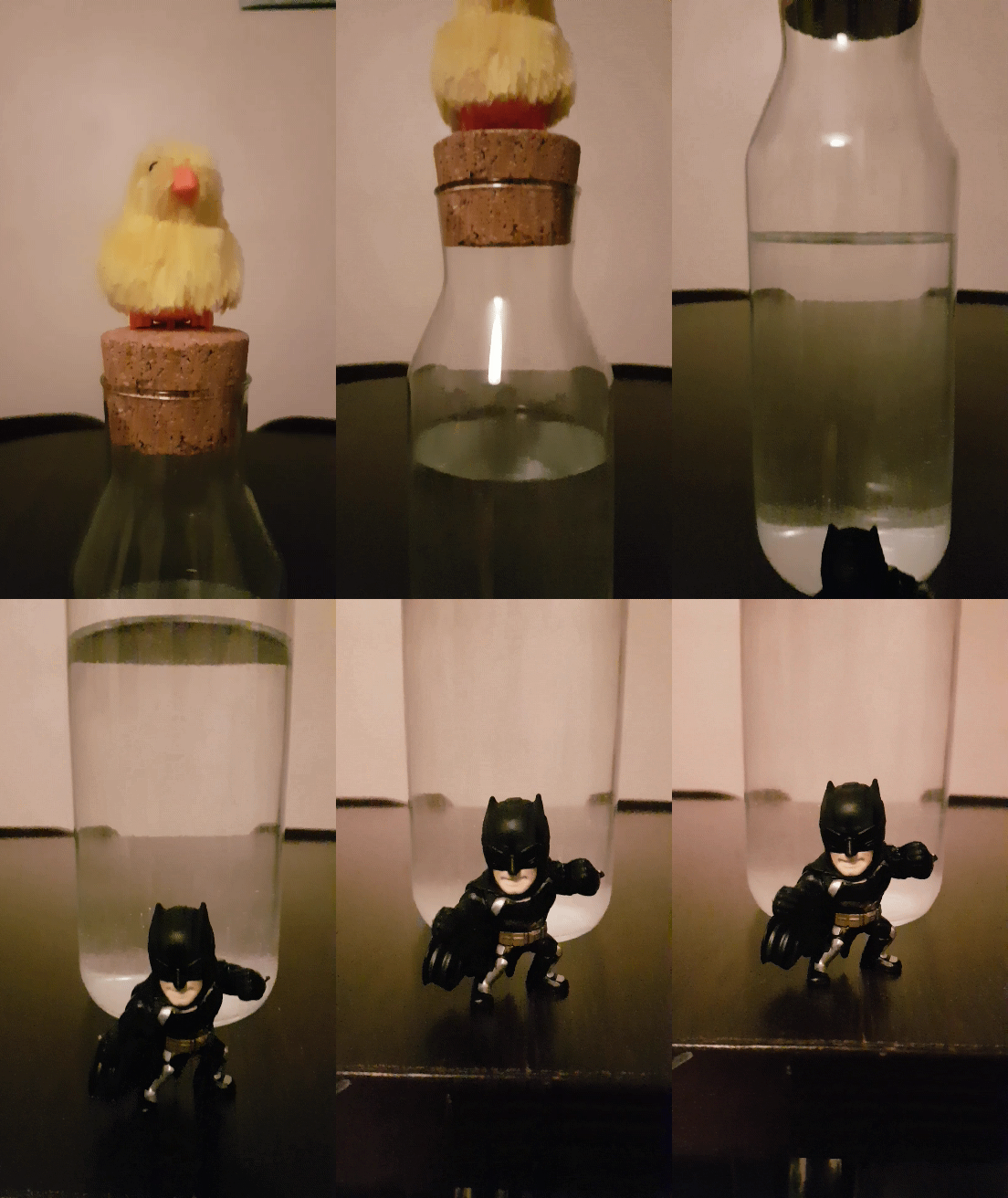
Tilt Shot
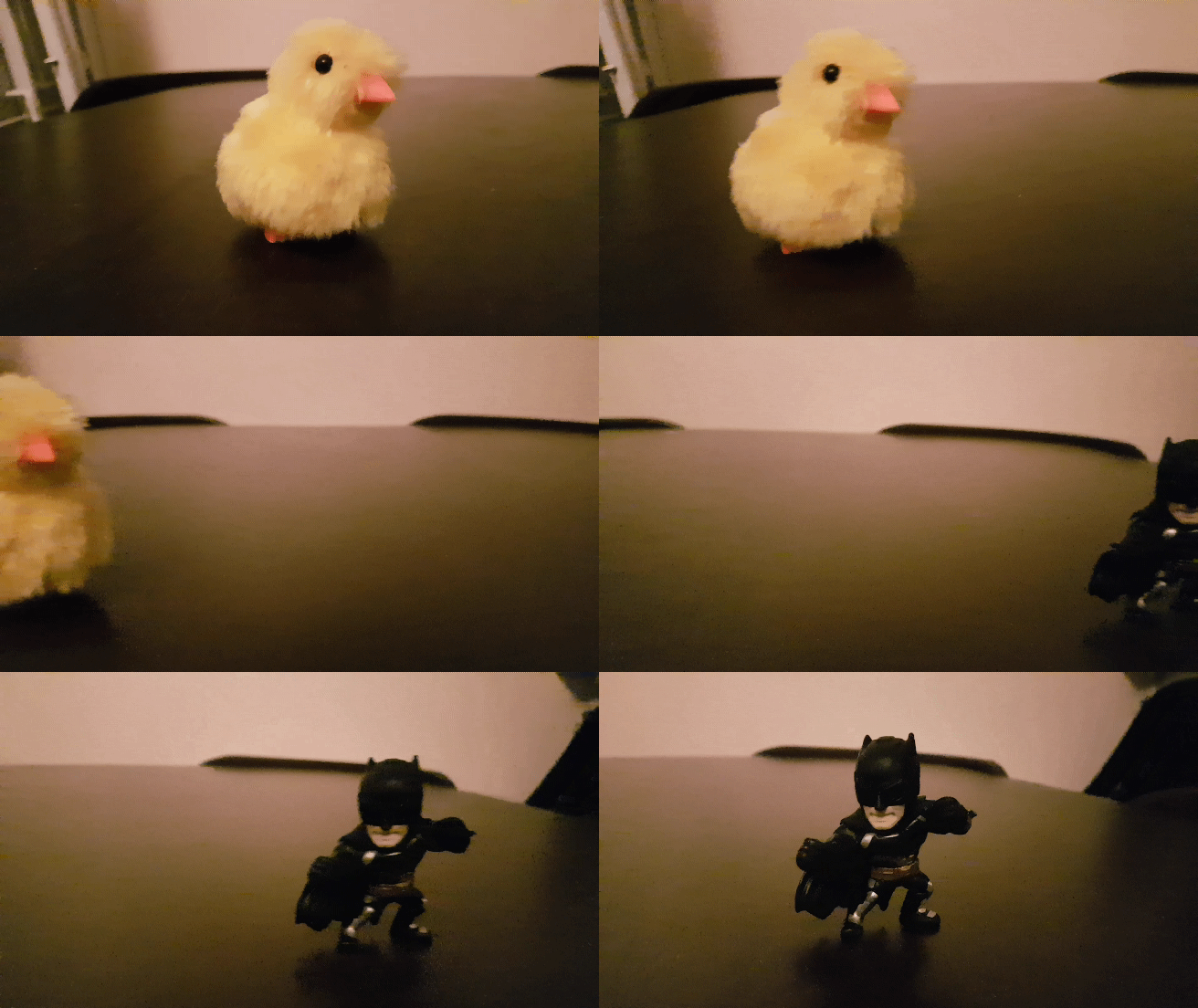
Pan Shot

Dutch Angle

Over the shoulder POV shot
These pictures I took represent different camera shots. The pictures vary from resolution to resolution, it gets more obvious the closer the camera is to the subject e.g. Extreme closeup as well as Big Closeup. The rest of the pictures have good quality although there is room for further improvement. Both Pan and Tilt shots couldn't have gone any better; my phone has a feature that allows videos to be converted to GIF images. Instead of uploading it as video, a GIF image upload was far more practical.


For my dream sequence, I used Sci-fi cartoons as inspirations - Invader Zim as well as Rocko's Modern life. It seemed appropriate for a child to become an astronaut or a space traveller. I have used single point perspective for the first image.


These are the three characters I drew on my own time, I've gone through some refined drawings, several line-ups of the each character as well as frankenstein drawings and thumbnails. These characters were inspired by several cartoon shows like The Grim Adventures of Billy and Mandy, Batman: The animated series as well as invader Zim


Week 5 - 7
For this week I will be discussing The Gestalt Theory.
In the 1920’s, the Gestalt Theory was introduced; it is a set of laws that describe how humans perceive objects by grouping objects that are similar, acknowledging shapes and patterns as well as simplifying objects that are of complex nature. These can be a useful practice for designers that have implemented perspective into their designs that could potentially engage an audience.
Gestalt is German for “Unified Whole” and has represented by early 20th century psychologists Max Wertheimer, Kurt Koffka and Wolfgang Kohler, all three have knowledge of how humans perceive from chaotic stimuli. They identified a set of laws where the mind “tells” what the eyes see via understanding images or illusions.

From left to right: Max Wertheimer, Kurt Koffka and Wolfgang Kohler
Gestalt theory has been implemented into modern designs such as logos and advertising. Many graphic designers sought to use these theories into their work so that audiences and viewers alike will perceive the organisation in a positive manner.
Here are some the principles of Gestalt Theory:
-
Closure: to fill in gaps between elements to perceive a whole shape or image.
-
Proximity: Grouping similar elements together to perceive similarities
-
Common Fate: Grouping elements that go the same way
-
Common Region: grouping elements that are in the same/near region
-
Continuation: following the flow of the line
-
Convexity: perceiving convex shapes with concave shapes
-
Element Connectedness: grouping elements linked via foreign elements
-
And more…

Closure

Proximity

Continuation

Gestalt theory is not much as seeing as it is thinking; users need to understand what they see. For example, the closure theory we recognise the image easily when we perceive it; when gap is between elements are present, the brain will immediately pick up the “gap” and deconstruct that image into something that humans can understand.
Danny Antonucci:
Known Works: Ed, Edd n Eddy, Lupo the Butcher, Snotrocket
Danny Antonucci is a Canadian animator known for works such as Ed, Edd n Eddy and Lupo the Butcher. Born February 27, 1959, Antonucci started animating at the age of 14; at this age, he also made his very first cartoon. He attended Sheridan College of Visual Arts but subsequently dropped out to work for Canimage Production as an animator. Prior to this, he has worked on numerous shows such as The Smurfs, The Richie Rich/Scooby-Doo Show as well as The Flintstones Comedy Hour.

Antonucci is also one of the “edgiest” and “old school” artists out there, according to the Electric Playground interview, he encourages up and coming artists to draw on paper rather than working digitally. ‘As mentioned previously he is mostly known for creating Cartoon Network’s longest running series Ed, Edd n Eddy. This show was watched by kids and adults alike and to this day, still garners a cult following.
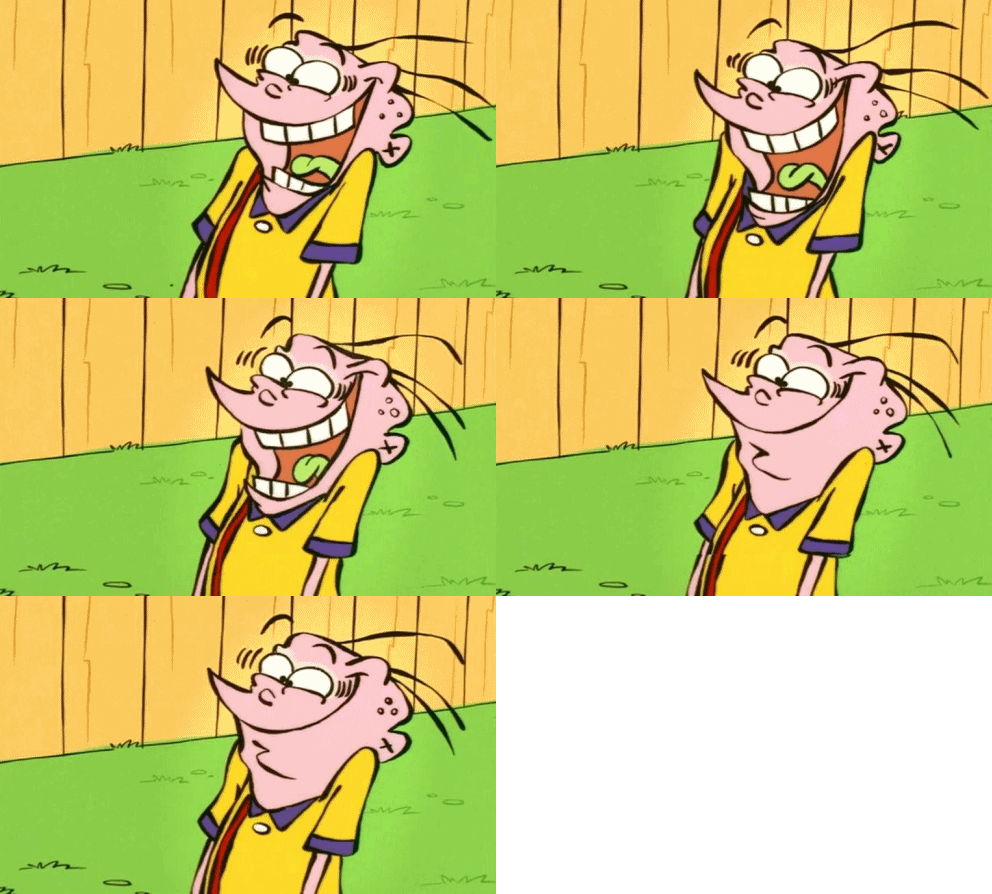
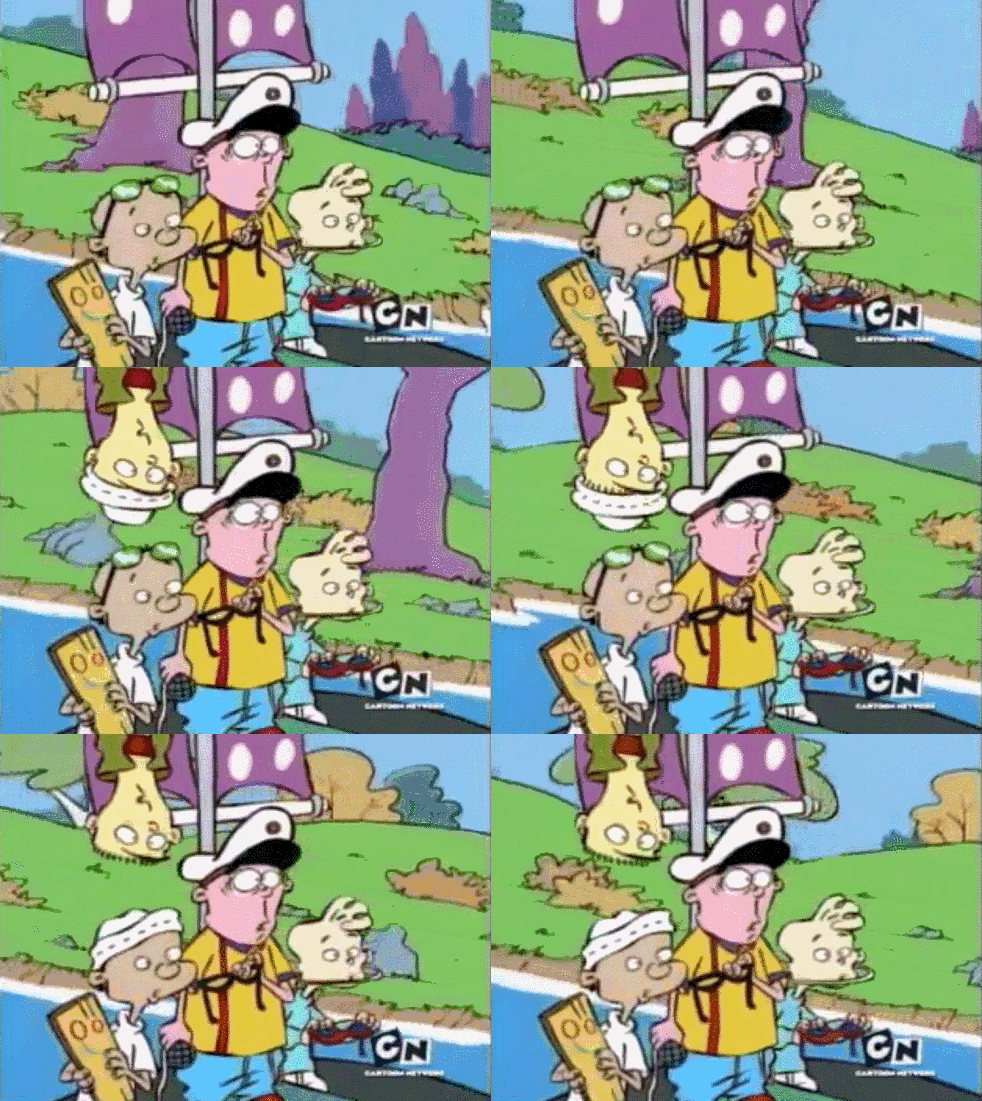
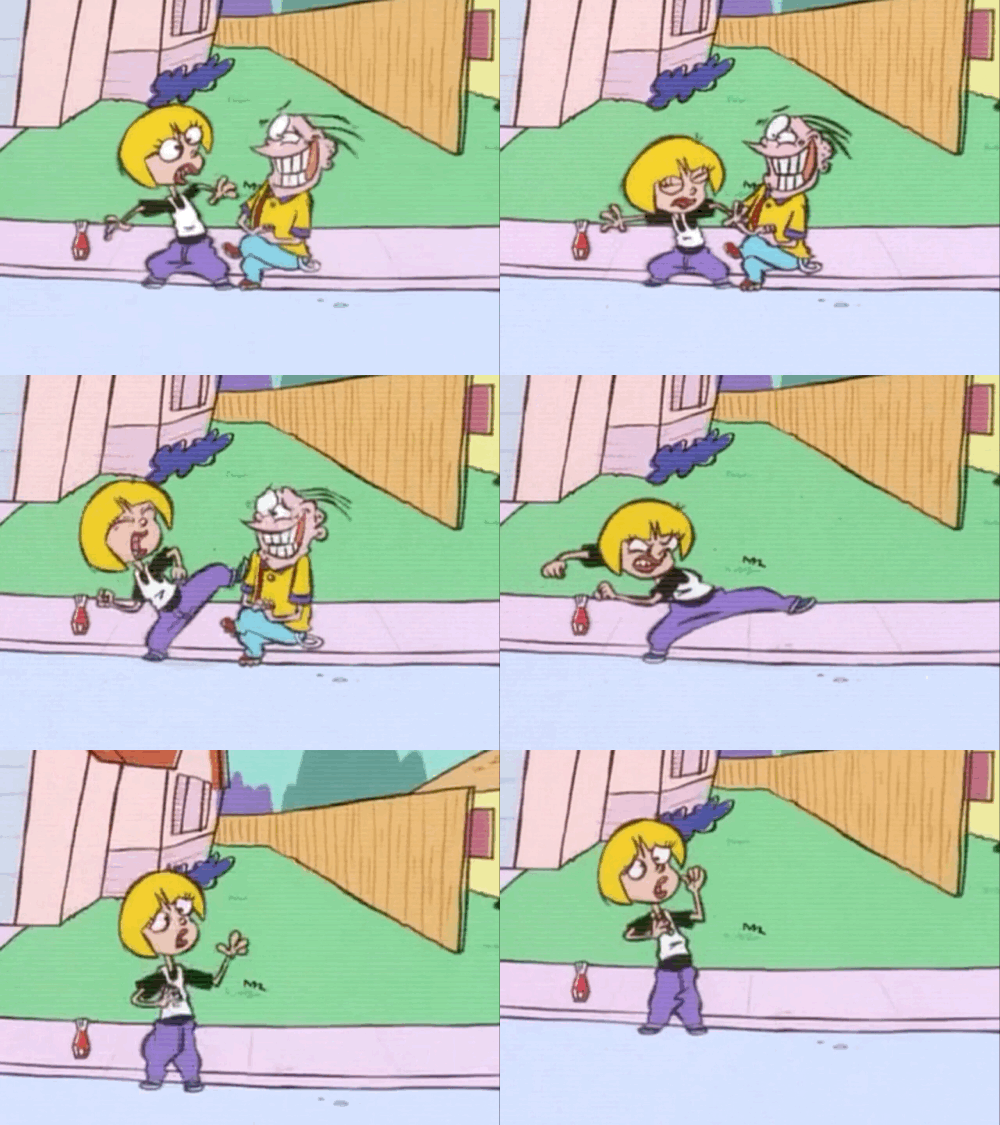
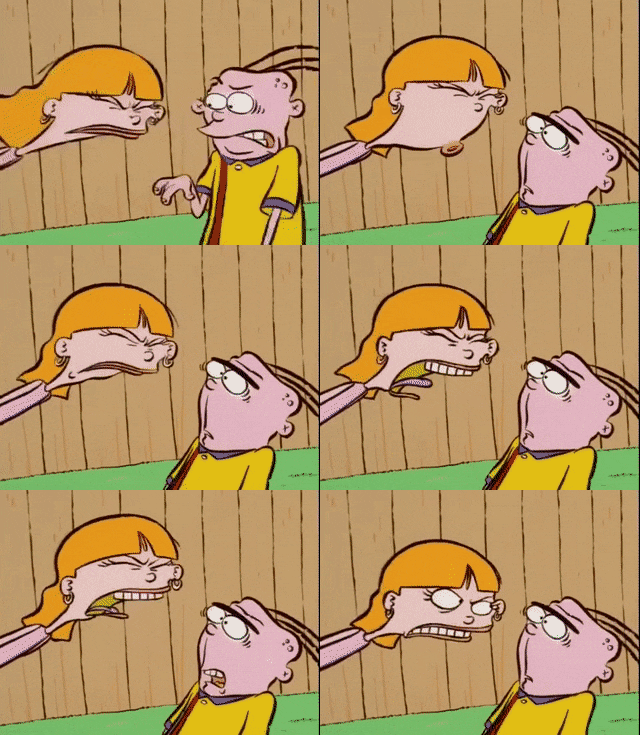
What I like about this series is not only for the sake of nostalgia but also for its surrealism and absurdity. I also admired the processes of his work; rather than doing them digitally, he and his team of artists “approached it in a classical sense” which is to simply put, hand drawn, and hand made. It is one of the last modern shows of this era to uses these processes, which I both admire and respect to its full extent.
Edd Ed n Eddy is also one of the last cartoon shows to implement “boiling lines” or boiling technique, Antonucci himself said that it “keeps the characters alive”. What I like about this technique is it gives the sense of liveliness and excitement represented by the characters; as if the characters can’t stop fidgeting and moving around, similar to a childish behaviour. Antonucci also used this technique to pay homage to cartoons of the 1930s; where animation was in it’s “classic era”.
Danny Antonucci Electric Playground Interview
Ed Edd n Eddy Behind the Scenes documentary
"The Boy Genius" Pre Production
The Boy Genius”. Is the current working title – I am at the preliminary stages and the title may change during the course of the project.
Proposal for “The Boy Genius”
The idea I intend to propose for this project is through my childhood and my memories of watching Saturday Morning cartoons whilst growing up. I believe that fond memories of these cartoon shows will bring familiarity and a sense of nostalgia that I thrive myself with. I will be combining this nostalgic sense with another aspiration; game design and I will be implementing gameplay to my work. This could result in a project that will assist me in building a foundation of originality within my work.
The Game will consist of 2 main characters, the “Boy Genius” himself and the “Robot Friend” he built for himself, both of which the player controls. The Boy Genius is somewhat of an outcast and a nerdy/geeky character, he is extremely intelligent and spends all day in his room reading books and browsing on his computer. He builds himself a Robot Friend that will help him get through his social anxiety, they go through an adventure that will take place within their home town, they will meet interesting, colourful and hostile characters, they will either befriend or fight.
This is taken from several inspirations, these include Ed, Edd and Eddy, Dexter’s Laboratory, Invader Zim and Fairly Odd Parents. All these cartoon shows have one thing in common between them: Most of the main characters are identified as outcasts and some of them are - to some extent - intelligent. The humour is somewhat oddball and slapstick, which I also intend to implement for this project. The humour I believe is what makes these cartoons important, reason being that its sole purpose is to entertain the audience. It will also fit in well with the gameplay, and implemented for the dialogue and interactions between the main characters.
The game may go through several changes during its developmental stages. I intend to implement harmonising and complementary colours that will fit in well with the environment and how each character is represented. I will use any available software that is flexible and will try to avoid any complexity within the process of making the game
Concept Drawings
I started off creating a concept for the environment. As clearly shown in here, shapes of the buildings and mountainous backgrounds have been approached with a realistic sense as opposed to the images below. I was at the first stages of the development and was building up ideas as I went along.
These drawings represent the earliest concept designs for my game. they have undergone through significant changes through its appearance to showcase development


Designs here became more prominent for the overall character design (which I am showcasing further). To match the overall distorted look for both main characters, I implemented a certain design choice inspired by artists from the likes of Butch Hartman and Genndy Tartakovsky. The environments fit with the aesthetic I was going for, the characters very much feel like they are close to home.


The Picture represented here was inspired by The Simpsons, however using a different colour palette, I was able to implement harmonising colour to some objects i.e. the cupboards.
Concept Design - Kitchen/Dining Area

Another picture inspired by an old cartoon programme Dexter's Laboratory, however instead of using a dark blue/grey colour palette, I made it brighter to represent the main character's personality. I experimented with this drawing, I drew this picture with a ballpoint pen just before colouring it in.
Concept Design - Laboratory

Billy and Mandy was used as inspiration for the drawing, using a different colour palette, and Billy's bedroom for the overall design i was able to emulate certain aesthetic; a unorganised, and messy room
Concept Design - Bedroom

Rather than using a cartoon show for this drawing, I used one of Bob Ross paintings and made it overly exaggerated rather than realistic. I also implemented some experimental methods, therefore I drew the outlines with a ballpoint pen just before colouring in the picture.
Concept Design - Sunset & Mountains

To show the main character building his robot I drew this picture. this is one of the later concept designs I created, this may change during development.
Concept Design - Assembly

An early concept design for the city, coloured to make it more "alive". Notice how building shapes are not overly exaggerated. This was also drawn using a ballpoint pen to show experimentation. I coloured the picture in to give the characters and the overall city "life".
Concept Design - Early City Concept

Later on, I decided to create another location for the game, a small town overlooking the city from a distance, this was taken from several cartoon shows, Invader Zim, Dexter's Laboratory, Rocko's Modern life etc. The colour palette was also given to emulate these cartoon shows.
Concept Design - Neighbourhood overlooking City

This was drawn simply showcase different renditions of the Boy Genius' bedroom. This was an much earlier concept, there is very little mess and other miscellaneous objects; this room has less characteristics and traits that matches the Boy Genius Personality.
Concept Design - Robot Recharging.
Photographs
The 6 pictures I took were from my home town Croydon, one of the inspirations I used for my environments were from the urban structures located within certain locations; from tall buildings to industrial construction. Some of these pictures are also from my neighbourhood, which consists of factories and a water tower that rises and descends. These have always fascinated me and have always wanted to implement them to signify a grimy aesthetic within the main characters' neighbourhood.


Mood Boards
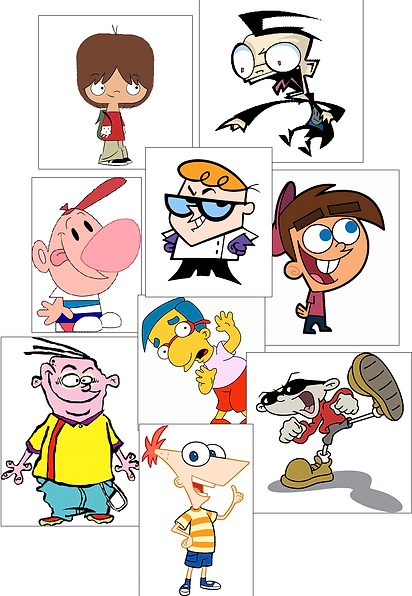
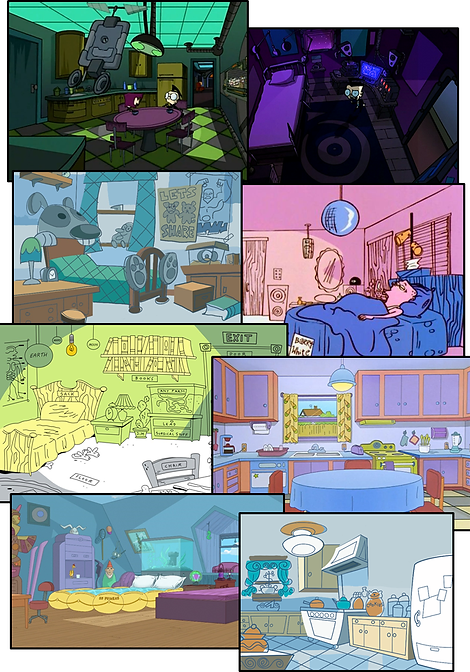
Below are the 4 Mood boards that have been used to give me an idea of what the main characters and the overall environment would look like. These Illustrations are from various artists: Danny Antonucci, Jhonen Vasquez, Dan Povenmire and Jeff "Swampy" Marsh as well as Butch Hartman. What these Drawings have all have in common are their over the top representation and disproportionate appearances.


A3 Drawings w/ annotations
Below are the A3 drawings I did, they have been annotated to signify any certain components as well describing traits each object has.


Mind Maps
Below is the mind map I drew to give me an idea of what traits both main character have.


Character Design Concepts
This section continues the pre-production of "The Boy Genius" this includes the thumbnails, early concept designs, turn-arounds and final design.
Thumbnails


The general design idea I had for the main characters was their overall shape. My aim was to create a disproportionate character, I was inspired by early 2000s cartoons with over the top designs and visuals represented both within environments and character design. Cartoonists Like Jhonen Vasquez (Invader Zim), Maxwell Atoms (Billy and Mandy) as well as Danny Antonucci (Ed, Edd n Eddy) were significant for the overall design and concept.
Earliest Drawn Concept


This is the earliest known drawing that I came up with, it bears similarity to Invader Zim's known characters GIR and Dib Membrane. This was later scrapped to avoid further similarity between the show and my concept designs
Turnarounds and Lineup


Final Concept
After countless hours of illustrating concept drawings, I have finally come to conclusion that these will be my final rendition of The Boy Genius and his Robot Buddy.


